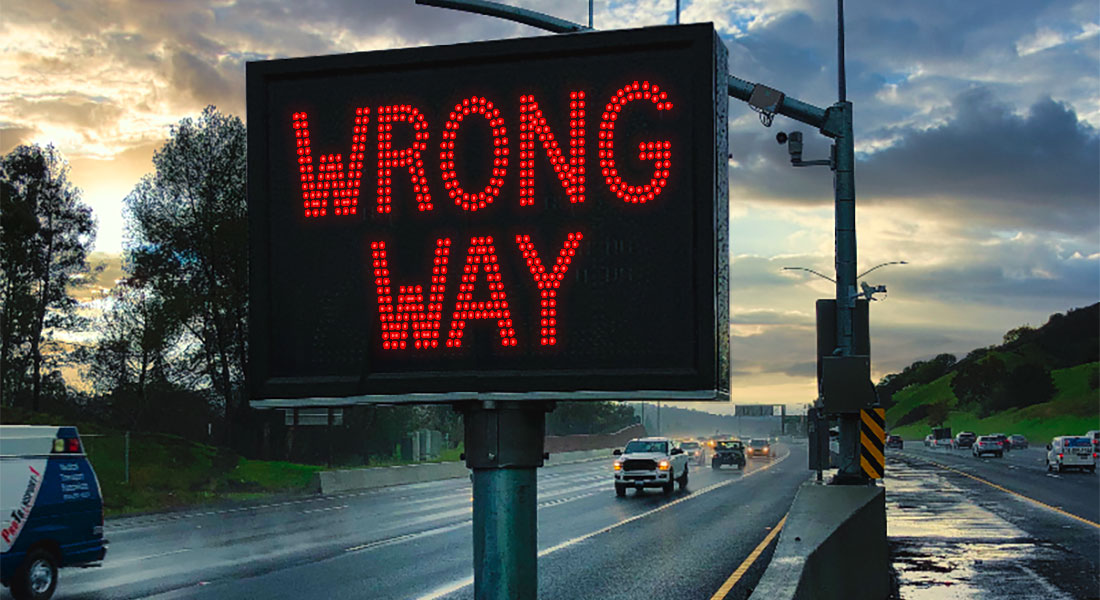
Wrong-way driving on highways and ramps is very rare. However, when it does happen, it’s incredibly deadly. Head-on crashes at highway speeds are extraordinarily unforgiving. According to the Federal Highway Administration (FHWA), wrong-way driving crashes are far more likely to result in fatalities than typical roadway incidents. That risk is precisely why an illuminated wrong way traffic sign has become a critical safety upgrade.

Discover
Signal-Tech’s Traffic and
Transportation Solutions
Why Are These Signs Needed?
Traditional signs, such as “Do Not Enter” and “Wrong Way,” rely on driver attention and sobriety. These two things are often missing in wrong-way crashes. According to the FHWA, most wrong-way driving incidents occur at night and frequently involve driving under the influence of alcohol at complex intersections.
An illuminated wrong way traffic sign addresses this by actively demanding driver attention to alter driving behavior. Instead of passively reflecting headlights, these signs use super bright LEDs to display or even flash their warning message when a vehicle enters a ramp or roadway in the wrong direction, providing immediate and unmistakable feedback to the driver.
Where Are These Signs Most Commonly Installed?
These LED signs are most commonly deployed at freeway exit ramps, as these points are consistently identified by FHWA research as the primary entry points for wrong-way drivers. They are also used on one-way urban roadways and at complex interchanges.
Regarding geographic locations of these illuminated signs and detection systems, Connecticut has been a national leader, installing more than 200 wrong-way detection systems at high-risk ramps statewide. Utah, Rhode Island, Massachusetts, and Nevada have followed suit, integrating illuminated signage with intelligent transportation systems (ITS) to monitor and respond to incidents in real time.

Download
Signal-Tech’s Traffic and
Transportation Product Catalog
Do These Signs Show Measurable Improvements in Accident Reduction?
Short answer, yes — and the data is nearly indisputable, and examples are numerous.
Traffic authorities in Connecticut reported that nearly 600 vehicles traveling the wrong way self-corrected, turning around to avoid entering traffic, after seeing an illuminated wrong way traffic sign. In another analysis period from Connecticut, the state observed a 41 percent reduction in roadway fatalities following widespread deployment of illuminated warning signs.
Rhode Island DOT data shows that at 29 ramps equipped with wrong-way illuminated signage, only one crash and zero fatalities occurred over seven years. Florida research published through the Transportation Research Board found that wrong-way incidents dropped significantly at sites equipped with flashing LED warnings compared to untreated ramps.
These findings consistently demonstrate that an illuminated wrong-way traffic sign is not only a visible warning but also an effective means of changing driver behavior before a crash occurs.
Read How
LED Wrong Way Signs Contribute
to Vision Zero
The Road Ahead
Unfortunately, there is no single solution to eliminate wrong-way driving completely. However, illuminated signage is one of the most cost-effective countermeasures currently available. In the future, a wrong way traffic sign and detection system may be able to integrate with connected vehicles, allowing in-car alerts or automated responses when a wrong-way event is detected.
An illuminated wrong way traffic sign turns the silent warning of a blade sign into an active intervention. They give confused drivers a final, unmistakable cue to correct their path. They also give traffic managers the means needed to help prevent the highway’s worst-case scenario. Deadly mistakes don’t announce themselves. These signs do.
A Proven Countermeasure with Real-World Impacts
Wrong way driving is one of the most dangerous roadway events; it’s rare, unpredictable, and often fatal. Illuminated signage directly addresses the core challenges of wrong way driving: poor nighttime visibility, driver confusion, and delayed response. A wrong way traffic sign moves beyond passive signage and into the realm of proactive safety intervention. Strategically placed at high-risk exit ramps and complex interchanges, they are now widely recognized as one of the most effective and scalable countermeasures against wrong way driving.
For transportation agencies, municipalities, and the partners who support them, the takeaway is clear: illuminated wrong way traffic sign systems are no longer experimental. They are proven, deployable, and increasingly expected as part of a modern roadway safety strategy.
If improving safety, visibility, and response time is a priority, contact Signal-Tech’s knowledgeable sales team to explore illuminated wrong way traffic sign solutions.