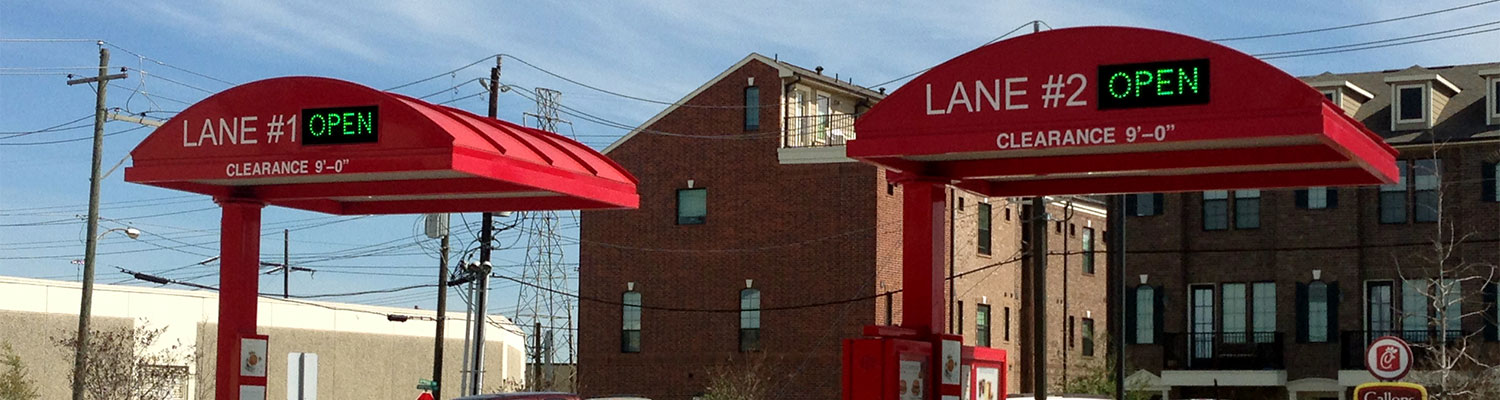
Speed is the name of the game in the quick service restaurant (QSR) industry. Every hesitation in a drive-thru lane costs time, reduces throughput, and diminishes customer satisfaction. As mobile ordering continues to reshape drive-thru traffic patterns, the need for clear guidance has never been greater. That’s where LED drive-thru directional signs play a decisive role. These signs don’t just inform; they direct behavior, reduce friction, and keep vehicles moving with purpose.

Learn More
About Signal-Tech’s QSR
Drive-Thru Solutions
Why Lane Confusion Is a Growing Problem
Modern QSR drive-thru lanes are no longer single-path systems. Many locations now operate with dual lanes, mobile pickup options, and evolving workflows that change throughout the day.
Without clear direction, drivers are left to interpret the layout on their own. That leads to:
- Hesitation at entry points
- Last-second lane changes
- Backups at merge points
- Slower ordering and pickup times
One uncertain driver can delay an entire line. Multiply that across peak hours, and the operational cost can become pretty substantial.
How LED Drive-Thru Directional Signs Improve Flow
Effective drive-thru directional signs eliminate guesswork before it begins. Positioned correctly and designed for instant readability, they guide drivers into the correct lane before hesitation occurs.
Key functions include:
- Clearly marking “Order Here” or “Mobile Pickup” lanes
- Using arrows to direct traffic flow intuitively
- Reinforcing decisions before and after lane entry
- Maintaining visibility in all lighting and weather conditions
When drivers know exactly where to go, they commit faster and move with confidence.
Need A
QSR Pickup Window Sign? Check
Them Out Here
The Critical Moment: Entry Point Decision-Making
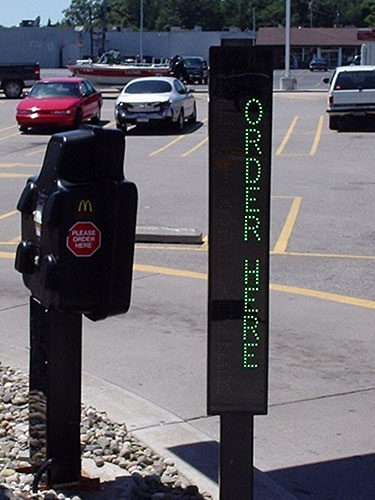
The most important point in any drive-thru isn’t the menu board or the payment window. It’s the entrance. This is where drivers decide:
- Which lane to choose
- Whether they’re in the right place
- How quickly they can proceed
Without strong visual cues, decision-making slows down. With properly placed LED drive-thru directional signs, it becomes automatic. Early placement is key. Signs should appear before lane splits, giving drivers enough time to react without braking or second-guessing.
Messaging That Works in All Scenarios
In drive-thru environments, clarity is more important than creativity. Drivers have seconds to process information, often while navigating tight spaces. High-performing LED drive-thru directional signs follow a few simple rules:
- Keep language direct: “ORDER HERE” and “PICKUP ONLY” outperform anything clever
- Use arrows with text: Direction plus confirmation increases comprehension
- Limit word count: Fewer words mean faster decisions
- Prioritize contrast and size: Readability at a distance is non-negotiable
If a message requires thought, it’s too slow.
Read How
Outdoor Directional Signs Help QSR
Drive-Thru Efficiency
Operational Benefits
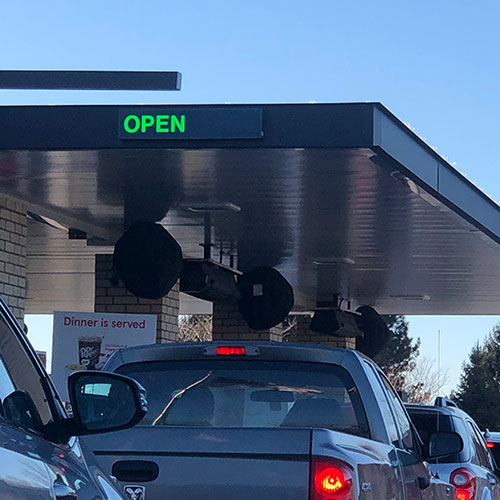
The impact of well-implemented LED drive-thru directional signs goes beyond aesthetics. It directly affects performance metrics that operators care about, including:
- Increased cars served per hour
- Reduced order delays
- Improved experience for mobile order customers
- Fewer traffic conflicts and lane corrections
- Less reliance on staff to direct vehicles manually
For high-volume locations, even small efficiency gains translate into meaningful revenue increases.
Designed for Real-World Conditions
Not all signage performs equally in a drive-thru environment. The effectiveness of LED drive-thru directional signs depends on how well they handle real-world challenges. Critical design considerations include:
- Brightness and visibility in daylight, nighttime, and poor weather
- Durability to withstand temperature swings and precipitation
- Mounting flexibility for optimal positioning
- Consistent legibility from various approach angles
In regions with frequent snow, rain, or glare, these factors become even more important. A sign that disappears in bad conditions creates more problems than it solves.
Learn
Six Reasons to Upgrade to an
LED Sign
Supporting Mobile Ordering Growth
Mobile ordering continues to expand, but physical layouts often lag behind. Without a clear separation between order and pickup traffic, both experiences suffer. Strategically deployed LED drive-thru directional signs help bridge that gap by:
- Creating clear expectations for app users
- Preventing mobile customers from entering order lanes
- Reducing friction for first-time pickup users
- Supporting dedicated or flexible lane configurations
As ordering channels diversify, signage becomes the translator between digital intent and physical movement.
Future-Proofing Drive-Thru Operations
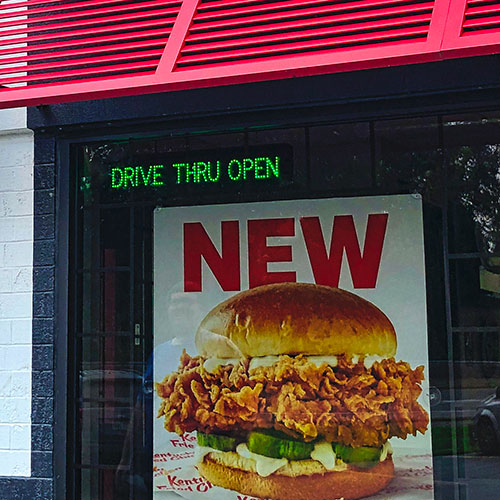
Drive-thru lanes are evolving toward smarter, more responsive systems. Signage is following that trajectory. Forward-thinking operators are beginning to explore:
- Dynamic lane messaging based on demand
- Integration with POS and mobile order systems
- Triggered messaging tied to vehicle detection
- Real-time adjustments during peak periods
In this environment, LED drive-thru directional signs are no longer static tools. They are part of a broader strategy to optimize flow in real time.
Drive-thru performance hinges on clarity at critical decision points. When drivers hesitate, operations slow. When direction is obvious, everything moves.
LED drive-thru directional signs remove uncertainty, guide traffic efficiently, and support the growing complexity of modern QSR layouts. For operators and resellers alike, they represent a practical, scalable way to improve both speed and customer experience.
Ready to improve drive-thru flow and eliminate lane confusion? Explore illuminated signage solutions designed for drive-thru environments or request a quote. As always, feel free to contact our knowledgeable sales team with any questions!