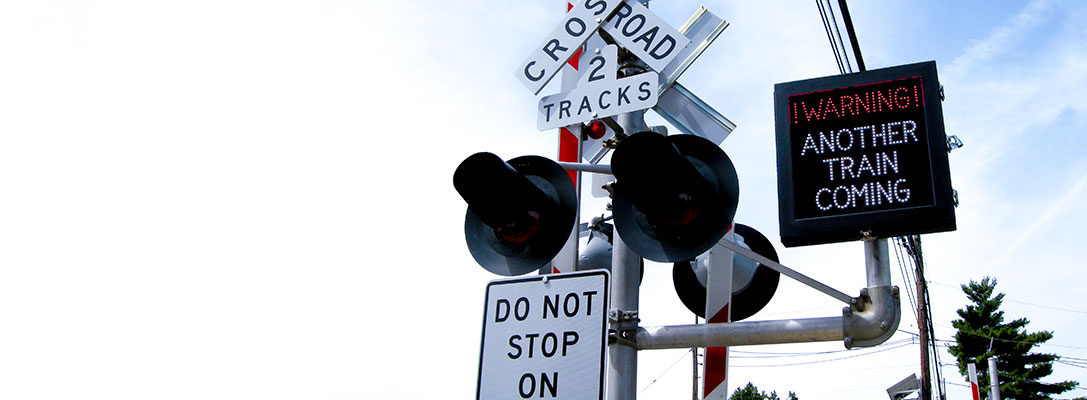
Modernizing rail transit infrastructure involves more than upgrading trains, tracks, and control systems. As agencies invest in new technology and expand service, they must also consider how motorists, pedestrians, and other roadway users receive critical safety information.
Railway warning signs are an important part of that equation. When properly specified and integrated, activated LED signs can communicate approaching trains, temporary turn restrictions, and other hazards at locations where rail operations intersect with public activity. For transit agencies planning improvements that may serve communities for decades, warning signage should be considered from the earliest stages of modernization.

Discover
Signal-Tech’s LED Train Warning Signs
Why Railway Warning Signs Matter in Rail Transit Modernization
Rail modernization projects frequently prioritize major investments in signaling, communications-based train control (CBTC), and the replacement of aging infrastructure. However, improvements to train operations don't automatically address every safety concern at crossings and other public access points.
The Federal Railroad Administration (FRA) identifies highway-rail grade crossings as the second-leading cause of rail-related deaths in the U.S., with more than 2,000 incidents and 200 fatalities occurring annually. These risks demonstrate the importance of evaluating how people interact with rail infrastructure.
LED railway warning signs can provide targeted, condition-dependent warnings at locations such as:
- Light rail intersections: Alert motorists to approaching trains or temporary turning restrictions.
- Pedestrian crossings: Communicate when crossing tracks is unsafe.
- Multi-track crossings: Warn pedestrians or drivers that another train may be approaching.
- Transit stations: Reinforce safety messages where pedestrian movement intersects with rail operations.
These applications complement, rather than replace, required crossing protection devices.
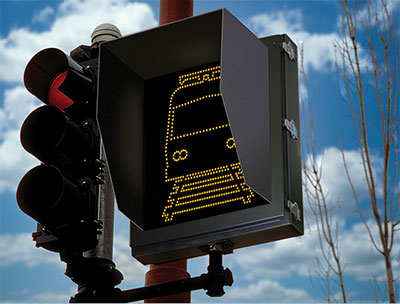
Start with the Safety Need, Not the Technology
Above all else, the most important part of any infrastructure project is identifying the problem to be solved. The Federal Transit Administration's Public Transportation Agency Safety Plans framework emphasizes identifying hazards, assessing safety risks, and developing appropriate mitigations.
That same approach should guide the selection of railway warning signs. Before specifying LED signage, transit agencies and engineering teams should answer several questions:
1 - What hazard needs to be communicated?
An approaching train, second train, or temporary movement restriction may require different warnings.
2 - Who needs the information?
Motorists, cyclists, and pedestrians encounter different visibility and reaction-time challenges.
3 - When should the warning activate?
Timing must align with the approved detection and control arrangement.
4 - Where should the sign be installed?
Placement should account for sightlines, traffic movements, obstructions, and environmental conditions.
5- How will performance be verified?
The project should establish requirements for message visibility, activation, deactivation, and testing.
By defining these requirements early, agencies can evaluate appropriate solutions without allowing equipment selection to dictate the safety strategy.
Learn More
About Signal-Tech’s LED Blank-Out
Signs
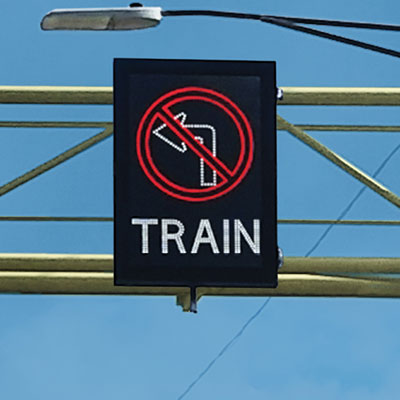
Integrating LED Railway Warning Signs with Existing Infrastructure
Successful modernization requires coordination between new equipment and existing infrastructure, and LED warning signs are no exception.
Depending on the application, LED blank-out signs can illuminate a warning message or symbol when activated by an external control signal, then return to a blank state when the warning is no longer required.
For example, an approved control arrangement might activate a "DANGER! ANOTHER TRAIN COMING" warning at a multi-track crossing or display a turn restriction when a light rail vehicle approaches an intersection.
Integration planning should address four essential considerations:
1 - Control compatibility
Confirm how the sign will receive activation and deactivation commands.
2 - Power requirements
Identify available voltage and electrical infrastructure.
3 - Installation conditions
Evaluate mounting locations, environmental exposure, and maintenance access.
4 - Testing and reliability
Establish acceptance criteria, inspection procedures, and appropriate responses to equipment or communication failures.
The FHWA's Manual on Uniform Traffic Control Devices (MUTCD), Part 8, establishes national standards for traffic control devices at railroad and light rail grade crossings, including pathway and sidewalk crossings. The MUTCD also addresses Light Rail Activated Blank-Out signs under Section 8B.17. Sign selection and installation must follow applicable requirements and project-specific engineering evaluations.
Importantly, LED signs should not be assumed to interface directly with CBTC or other train control systems. Integration depends on the approved architecture and applicable safety requirements.
Signal-Tech Tip: Look for the MUTCD alphanumeric code on Signal-Tech products to see illuminated signs that align with MUTCD guidelines. You can also enter unique MUTCD alphanumeric codes into the search bar on Signal-Tech.com to find products that align with MUTCD guidelines.
Explore
Signal-Tech’s LED Light Rail &
Pedestrian Warning Signs
Building Long-Term Reliability into Railway Signs
Modernization investments are intended to deliver lasting value. Warning signage should be evaluated with the same long-term perspective as other rail infrastructure. Key considerations include:
1 - Environmental durability
Cabinets and electrical components must withstand the conditions at their installation locations.
2 - Visibility
Messages must remain readable under expected daylight, nighttime, and weather conditions.
3 – Maintainability
Equipment should allow practical inspection, servicing, and replacement.
4 – Adaptability
Sign specifications should account for potential changes in operations and infrastructure.
The FRA's Grade Crossing Inventory provides information that can support crossing improvement planning, while the FTA's safety performance guidance emphasizes evaluating whether safety investments achieve their intended objectives. Together, these resources reinforce the value of evidence-based planning and ongoing performance evaluation.
Making Warning Signage Part of the Modernization Plan
Rail transit modernization presents an opportunity to reconsider how safety information is delivered throughout a transportation network. Rather than treating railway warning signs as accessories selected near the end of a project, agencies should evaluate them alongside other crossing infrastructure and operational requirements.
The goal shouldn’t be to install newer signs. It should be to ensure the right warning reaches the right audience at the right time. When signage is considered early in the process, rail modernization projects can better align public-facing safety communication with long-term operational needs.
Signal-Tech manufactures LED light rail and pedestrian warning signs, as well as grade crossing warning signs, including customizable blank-out messages for application-specific requirements. Contact our knowledgeable sales team for help with your next rail modernization or project. Or, if you’re ready to order, request a quote!


