
Pedestrian safety is at the forefront of traffic engineering priorities. Data from the Governors Highway Safety Association shows a steady increase in pedestrian fatalities, many of which occur at busy intersections where drivers fail to comply with turn restrictions or yield requirements. While enforcement and education play a role in improving compliance, signage remains a foundational tool in preventing conflicts between vehicles and pedestrians.
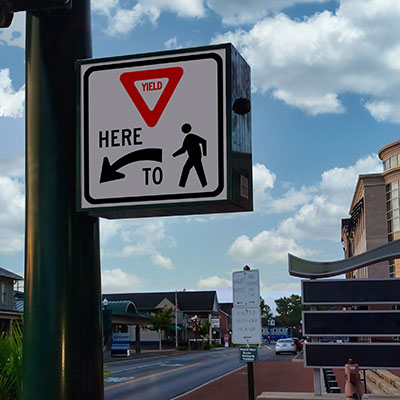
One solution is dual-state messaging pedestrian traffic signs. This technology is designed to deliver context-specific, illuminated instructions that can be changed anytime. By condensing multiple safety messages into a single, illuminated sign face that switches between two display states, these signs help reduce driver confusion, improve compliance, and make crosswalks safer.
Static Signs in Dynamic Environments Can Be Problematic
Traditional, static signs face two significant challenges: message overload and poor visibility. Many intersections, especially in urban settings, have poles cluttered with multiple signs — “No Right Turn,” “Yield to Pedestrians,” “Right Turn Yield to Pedestrians,” among others. When these instructions appear simultaneously, drivers may become overwhelmed or confused, overlooking the appropriate course of action at that moment.

Download
Signal-Tech’s Illuminated Traffic & Transportation Product Catalog
The second problem compounds this problem: low-visibility conditions. Rain, fog, snow, and night glare can obscure static signs, especially those placed high on poles or set back from the driver’s line of sight. Even highly reflective sheeting can’t always match the immediate visibility of an illuminated message. In situations where pedestrian safety depends on instant driver recognition, those lost seconds matter.
The Advantages of Dual-State Messaging Signs
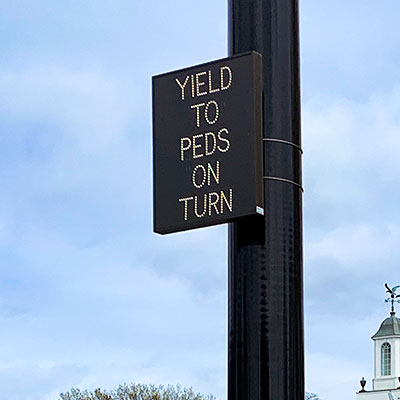
Dual-state messaging pedestrian traffic signs solve these problems by combining two sets of instructions into a single sign face that switches between illuminated and non-illuminated states. For example:
State 1 Illuminated: Displays “No Right Turn” with an overlaid, but extinguished/not illuminated, “Yield to Pedestrians” icon/text during restricted periods of heavy pedestrian traffic.
State 2 Illuminated: Shows a “Right Turn Yield to Pedestrians” message with an overlaid, but extinguished/not illuminated, “No Right Turn” icon/text during periods with light pedestrian traffic.
These signs reduce driver cognitive load by removing unnecessary messages outside of active restriction periods. These illuminated displays cut through weather conditions, darkness, and visual clutter, ensuring the instruction is unmistakable.

Learn How
Illuminated Traffic Signs Help Traffic
Flows in Congested Areas
For traffic planners and engineers, the adaptability of dual-state messaging pedestrian traffic signs is a major advantage. These signs can be integrated with existing traffic signal controllers to activate during:
- Pedestrian walk cycles
- Specific time-of-day restrictions
- Special event traffic management
- Construction detours
Synchronization ensures the displayed message is always relevant, increasing compliance rates and reducing the likelihood of pedestrian-vehicle incidents.
Proven Impacts on Safety and Additional Benefits
Field studies of illuminated and dynamic messaging signs have shown measurable improvements in driver behavior. In one Federal Highway Administration (FHWA) study of yield-to-pedestrian signs at urban crosswalks, compliance rates climbed from 27 percent to 59 percent after installation, a nearly 30 percent increase in drivers yielding to pedestrians. Further research by the Insurance Institute for Highway Safety (IIHS) found that adding crosswalk lighting made drivers more than three times more likely to yield to pedestrians. Combining lighting with illuminated signage and flashing beacons made them up to 13 times more likely to stop for pedestrians.
Discover
All of Signal-Tech’s Illuminated
Traffic & Transportation Signs
Dual-state messaging pedestrian traffic signs leverage proven visibility gains by focusing driver attention on the driving instructions that matter at the exact moment, such as restricting turns during active pedestrian crossing cycles. This approach helps reduce split-second decision errors and improves intersection safety.
While safety is the primary driver, there are other reasons to consider this technology, including:
Space and Clutter Reduction: One sign can replace two or more static signs, reducing pole congestion and improving intersection aesthetics.
Cost Efficiency: fewer signs mean fewer poles, brackets, and installation labor. Over the long term, reduced maintenance needs can provide substantial savings.
Scalability and Retrofit: Illuminated signs can be installed in existing intersections without significant infrastructure changes, making them ideal for retrofit projects and phased safety upgrades.
Regulatory Compliance: Signs can be designed to meet MUTCD standards for illuminated traffic control devices, ensuring they are both effective and MUTCD-compliant.
The Future of Pedestrian-Vehicle Safety at Intersections
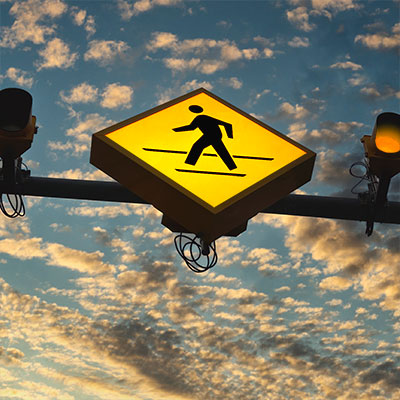
As urban population density increases and pedestrian traffic continuously grows, intersections will become more complex. Static signs have served well for decades, but the demands of modern traffic call for dynamic solutions. Pedestrian traffic signs provide clarity when it matters most, such as when lives are on the line in a crosswalk.
For traffic planners, the path forward is clear: combine proven safety principles with adaptable, high-visibility technology. For resellers, the message is equally straightforward: this is a product category poised for growth, backed by measurable safety benefits and long-term cost savings.
Learn Why
Illuminated Signage Is a Key
Component of Vision Zero
In an era where cities strive for zero pedestrian fatalities, tools that improve compliance without adding roadside clutter are worth the investment. By guiding drivers with precision and timing, dual-state illuminated signs are not just a technological upgrade but a practical step toward safer streets. Contact our illuminated traffic and transportation signage team to learn more about illuminated pedestrian traffic signs!