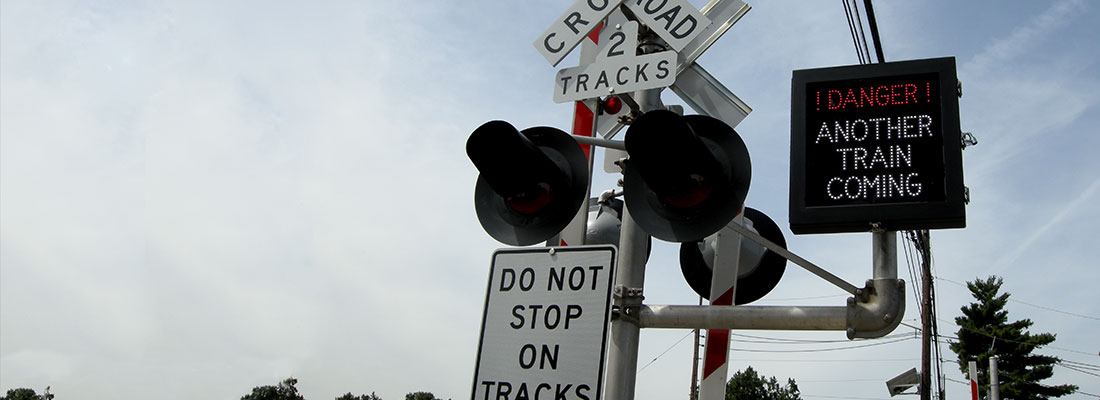
As cities expand and light rail systems become more integrated into city streets, safety at rail crossings is becoming more important than ever. Engineers and transit agencies are tasked with protecting both rail passengers and the general public — especially pedestrians and drivers who encounter trains in mixed-traffic environments. One of the most effective tools for improving visibility and reducing collisions is the use of LED blank-out technology as a modern railroad advance warning sign solution.
The Challenge of Mixed-Traffic Rail Environments
Light rail differs from heavy freight or commuter rail in one crucial way: it often shares space with vehicle and pedestrian traffic. That creates a complex environment where traditional static signs and gate arms alone aren’t always enough. Motorists and pedestrians may underestimate a train’s approach speed, become distracted, or fail to notice a standard railroad advance warning sign in time to react.

Download
Signal-Tech’s Rail Products Brochure
According to the Federal Transit Administration, most light rail collisions occur at or near crossings with inadequate warning systems. Many of these incidents are preventable with better communication and visibility. This is where LED blank-out signs make a difference.
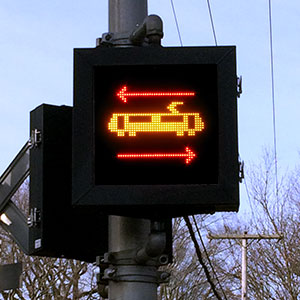
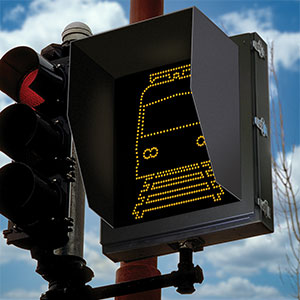
LED blank-out signs display a message that is completely dark until it’s activated by a control signal, typically tied to the light rail system’s signaling network or an approach sensor. When illuminated, the sign displays a clear, high-contrast message such as “TRAIN APPROACHING,” “DO NOT CROSS,” or a dynamic symbol recognized by drivers and pedestrians. Because the message is only visible when active, LED blank-out signs eliminate background clutter and visual noise — problems that plague traditional static signage in busy urban streets. This makes them ideal candidates for use as railroad advance warning sign systems in environments where constant illumination or motion can overwhelm the senses.
How Preemptive Warnings Work
Preemptive crossing warning systems use vehicle detection or signaling data to trigger LED blank-out signs before a train arrives at an intersection. The activation can occur several seconds earlier than traditional flashing lights, giving motorists and pedestrians more time to respond safely. For example:
- A train enters a designated pre-signal detection zone.
- The system communicates with traffic controllers or dedicated crossing logic.
- LED blank-out signs immediately display “TRAIN COMING” or a universally recognized symbol.
- When the train passes and the crossing clears, the signs automatically return to a dark, non-distracting state.

Discover
All of Signal-Tech’s Rail Industry
Solutions
This proactive approach extends the effective range of a railroad advance warning sign, allowing for smoother traffic flow, fewer abrupt stops, and a substantial reduction in near-miss events.
The Advantages of LED Blankout Signs for Preemptive Warnings
- High Visibility in Virtually All Conditions
LEDs provide bright, uniform illumination in daylight, rain, fog, or snow, often obscuring traditional reflectors or painted signs.
- Energy Efficiency and Longevity
Compared with incandescent lighting systems and signs, LEDs consume up to 80 percent less power and last years longer, reducing both maintenance costs and service interruptions.
- Integration with Modern Rail Control Systems
LED blank-out signs can connect directly to signal logic controllers, automated gates, or train detection loops, ensuring seamless synchronization with rail movement.
- Flexible Messaging, Design, and Customization
Unlike printed or painted static signs, LED modules can be programmed to display multiple warnings or symbols, offering flexibility for unique intersection layouts or multimodal crossings. They can also be customized to display specific messages for unique traffic scenarios.
- Enhance Public Perception of Safety
Well-lit, dynamic signage signals that transit authorities take safety seriously. Riders and motorists associate LED systems with modernity and reliability, which are key factors in public confidence.
Illuminated Signs and Compliance with Safety Standards and Regulations
Transit authorities implementing LED-based railroad advance warning sign solutions must adhere to federal and local requirements, such as the Manual on Uniform Traffic Control Devices (MUTCD). Further, agencies may find that LED signs and systems can facilitate or support Positive Train Control (PTC) or Transit Signal Priority (TSP) integration by providing real-time, responsive displays that mesh with detection and control logic.
Cities Already Reaping the Benefits of Light Rail LED Blankout Signs
Many municipalities have already deployed LED blank-out systems across multiple light rail corridors. These preemptive systems have produced measurable benefits, including:
Read How
Railroad Crossing Warning Signs
Keep Motorists & Pedestrians Safe
When used as part of a coordinated safety strategy — alongside audible alerts, flashing beacons, and physical barriers — blank-out signs hold the potential to transform rail crossings from reactive zones into proactive safety environments.
As urban transit continues to evolve, preemptive warning systems are quickly becoming an essential component of pedestrian, motorist, and light rail safety. LED blank-out signs provide a modern, highly effective railroad advance warning sign solution that reduces risk, improves compliance, and enhances the public’s sense of safety around light rail crossings.
Cities will continue expanding and mobility demands will continue to grow, so investments in intelligent, visible, and reliable signage will remain among the smartest and most cost-effective ways to protect lives and keep trains running safely on time. Click here to learn more about our LED signs for light rail applications, and click here to contact our illuminated rail signage experts!